The Central Kalahari Game Reserve (CKGR) is Africa's second-largest protected area at 52,800 square kilometres. To put that in perspective, it is larger than Switzerland. The CKGR is a vast, open, semi-arid landscape of ancient fossil river valleys (called pans and valleys) dotted with grass and scattered bushes. It is the opposite of the lush, water-rich north. Where Moremi and Chobe deliver wildlife in concentrated doses, the CKGR delivers solitude, space, and a handful of extraordinary sightings spread across vast distances. The Kalahari is not a true desert in the Sahara sense. It is a semi-arid savanna of red sand, sparse grass, acacia, and the occasional camelthorn tree. The fossil river valleys, Deception, Passarge, and Letiahau among them, are ancient drainage lines that no longer carry water but still shape where the grass grows and the game gathers. These pale, open valleys cutting through the darker bush are the heart of the reserve and where most self-drivers spend their time. The reserve was established in 1961, originally as a refuge for the San people and the wildlife they lived alongside. Its sheer size and deliberate lack of development are the point. There are no tar roads, no fences on most boundaries, and only a handful of basic campsites scattered across an area the size of a small country. For travellers who have done the northern parks and want something wilder and more self-reliant, the CKGR is the natural next step.
What makes Central Kalahari Game Reserve special
The CKGR is for travellers who value remoteness over convenience. You can drive for hours without seeing another vehicle. The campsites are simply a cleared patch of sand with no facilities at all. At night, the silence and the star-saturated sky are overwhelming.
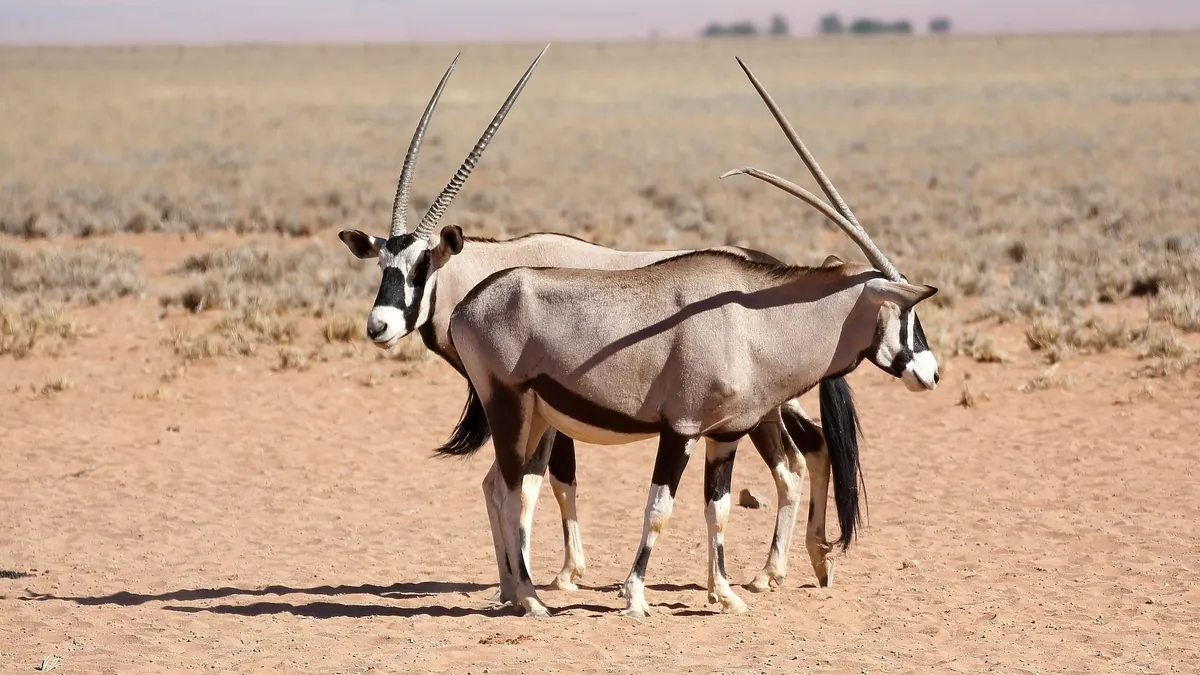
The wildlife that does inhabit the CKGR is uniquely adapted to desert conditions. The black-maned Kalahari lion is the icon: larger than lions in the north, with dramatic dark manes, these animals survive in conditions that would defeat most predators. Gemsbok (oryx) are the most common large antelope, perfectly evolved for the heat with their ability to survive without drinking water.
Deception Valley, the most famous area within the CKGR, was made famous by the book "Cry of the Kalahari" by Mark and Delia Owens. The valley's fossil riverbed attracts game during the green season and remains one of the best places in Africa to see brown hyena.
There is a particular quality to the solitude here that is hard to find anywhere else. On a clear night the sky is so dense with stars that constellations become hard to pick out, and the only sounds are the calls of jackals and, if you are lucky, the distant roar of a lion carrying across the flat ground. Days are spent moving slowly between valleys, scanning the grass for the shapes of resting cats, and evenings are spent beside a small fire with no other camp in sight. It is a safari stripped back to its essentials.
Self-drive suitability
The CKGR is for experienced self-drivers only. The sand is deep and relentless. Distances between campsites are long (often 50 to 100 km). Navigation requires GPS, as tracks can be faint or non-existent in places. There is no fuel, no phone signal, and no assistance.
The CKGR is best attempted as part of a longer Botswana trip, after you have built experience in Chobe and Moremi. A minimum of three nights is needed to justify the effort of getting in and out, and five nights allows for proper exploration.
Self-sufficiency is the governing principle. You must carry all your own fuel, water, food, and recovery gear, and you must be able to fix common problems yourself. A reliable second vehicle in convoy is a sensible precaution for first-time Kalahari visitors, since a breakdown or bogging in a remote valley could otherwise leave you stranded for a long time. Routes should be planned in advance with GPS waypoints, and you should always carry more water and fuel than your best-case calculation suggests.
This is not a destination for a hire-car-and-a-map approach. The travellers who come away raving about the Kalahari are the ones who arrive prepared, build in slack time, and treat the remoteness as the attraction rather than an obstacle to be rushed through.
Best time to visit Central Kalahari Game Reserve
Unusually for Botswana, the CKGR is best in the green season (December to April). The rains bring fresh grass to the fossil valleys, which attracts gemsbok, springbok, and wildebeest. The predators follow. This is when the Kalahari comes alive.
During the dry season (May to October), the CKGR is at its most barren. Wildlife disperses over huge areas, making sightings sparse. The experience is more about the landscape and solitude than the game. Some travellers prefer this stark beauty, but for wildlife viewing, time your visit for the rains.
There is a practical trade-off to weigh. The green season brings the best wildlife but also the risk of heavy rain turning the black-cotton soil near the pans into an impassable mire, and some tracks can become temporarily impossible. The dry season is easier to drive and more predictable, but the game is thin. If your priority is the famous Deception Valley predators, accept the greater driving challenge and come between January and April. If landscape and solitude matter most, the cooler dry months from May to August are more comfortable for camping.
Vehicle requirements
Full 4x4 capability is essential. The entire CKGR is deep Kalahari sand. Low range will be engaged for extended periods. Carry maximum fuel (long-range tank plus jerry cans), as there is no fuel within the reserve and distances between the gate and the main wildlife areas are over 100 km.
Two spare tyres are mandatory. A satellite communicator is essential. Sand ladders or maxtrax are strongly recommended.
A long-range fuel tank is close to essential given the distances involved. As a rough guide, budget for at least 400 to 500 km of range within the reserve on top of the fuel needed to reach and leave it, and carry jerry cans to cover the difference. A dual-battery system to run a fridge, a tyre compressor and repair kit, and a basic spares kit (belts, hoses, fuses, and fluids) round out a proper Kalahari setup. A satellite phone or messenger is not optional here; it is the difference between an inconvenience and an emergency.
Wildlife highlights
The black-maned Kalahari lion is the CKGR's crown attraction. Sightings are most common in the Deception Valley and Sunday Pan areas during the green season. These lions are magnificent, often seen resting on the open pan surface with their dark manes stark against the pale sand.
Gemsbok are everywhere and are endlessly photogenic against the desert backdrop. Springbok, hartebeest, and wildebeest fill the valleys during the rains. Cheetah are relatively common in the open landscape.
Brown hyena, bat-eared fox, and African wild cat are nocturnal highlights. Birdlife includes martial eagle, secretary bird, kori bustard, and the crimson-breasted shrike.
The predator density in the green season is what draws experienced safari-goers back year after year. Beyond the famous black-maned lions, cheetah use the open valleys as hunting grounds and are often seen on the move in the cooler hours. Leopard are present but secretive. The real specialities, though, are the smaller and nocturnal species: aardwolf, honey badger, Cape fox, and the striking bat-eared fox with its oversized ears. Patient night drives from the few camps that permit them, or simply sitting quietly at your campsite after dark, often produce the most memorable sightings.
Practical information
CKGR campsites are completely wild. There are no ablution facilities, no water, no shade structures, and no fences. You camp on a designated site (basically a GPS coordinate) in the open bush.
Book through the DWNP system. Popular sites in Deception Valley and Sunday Pan fill up in the green season. Less popular sites are often available.
Carry a minimum of 60 litres of water per person for a five-night stay. All waste must be carried out. Firewood can usually be collected on site.
The CKGR is home to San (Bushmen) communities. Respect their land and camps.
Plan your campsite bookings well ahead for the green season, as the handful of sites in Deception Valley and Sunday Pan are the most sought-after in the reserve and fill months in advance. If those are gone, the less-visited sites in the Passarge and Piper Pan areas offer even greater solitude and are often perfectly good for wildlife. Remember that there is no rubbish collection, no water, and no firewood supply at any site, so arrive fully provisioned and prepared to carry out everything you bring in. Leaving a clean camp is both a courtesy and, in a reserve this fragile, a responsibility.
Getting there
The main access point is Matswere Gate, approximately 270 km from Maun via a mix of tar and sand track. The drive takes 5 to 6 hours. An alternative is the Tsau Gate on the western side, accessed from Ghanzi (approximately 250 km of sand).
The CKGR is not practical to combine with the northern circuit (Chobe, Moremi) in a short trip. Most self-drivers visit it as a separate expedition or as an add-on to a 14-day or longer itinerary.
From Maun, the usual approach is to stock up completely, fuel to the brim, and aim to reach Matswere Gate with enough daylight left to reach your first campsite before dark, as driving the sandy tracks at night is slow and risks missing turns. Rakops, to the east of the reserve, offers a limited fuel option but should not be relied upon. Whichever gate you use, treat the drive in as the start of the expedition rather than a transfer: the sand is deep from the outset, and the sense of leaving the ordinary world behind begins the moment the tar ends.