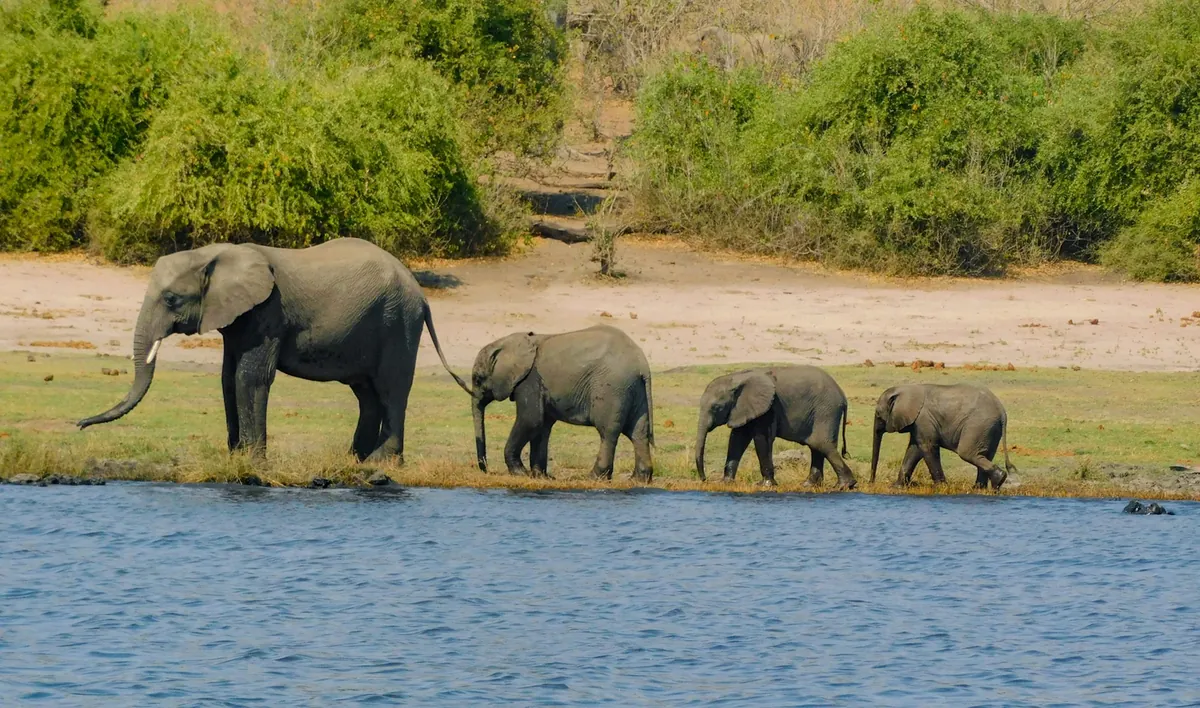
Chobe National Park is Botswana's first national park and its most accessible. Covering 11,700 square kilometres along the Chobe River in the far north, it holds the largest elephant concentration in Africa, with herds of several hundred regularly gathering at the river during the dry season. For self-drivers, Chobe offers something unusual in Botswana: a genuine range of difficulty levels. The Chobe Riverfront area near Kasane is one of the easiest self-drive experiences in the country, while the Savuti and Linyanti sections (covered in their own guides) are among the most challenging.
What makes Chobe National Park special
Chobe's defining feature is the river. During the dry season (July to October), the Chobe River becomes the only reliable water source for kilometres in every direction. This creates some of the most concentrated wildlife viewing in Africa. It is not unusual to see 500 elephants at a single stretch of riverbank, along with buffalo herds, hippo pods, and Nile crocodiles. The birdlife is exceptional year-round, with over 450 recorded species.
The park also offers genuine variety. The riverfront is lush and green, with tall trees and floodplains. Move south into the park's interior and the landscape shifts to dry Kalahari sand woodland. The Nogatsaa area in the southeast corner is a completely different ecosystem from the riverfront, with good sightings of sable and roan antelope that you will not find along the river.
Timing matters more at Chobe than almost anywhere else in Botswana. The riverfront fills with day visitors from Kasane lodges between about 9am and 11am, then empties again by early afternoon. Self-drivers who enter at the 6am gate opening get the river largely to themselves for the first two hours, which also bring the best light and the most active wildlife. Plan your days around that early window and the park feels far less busy than its reputation suggests.
Self-drive suitability
The Chobe Riverfront is one of the most accessible self-drive areas in Botswana. The roads from Kasane to the park gate are gravel and well-maintained. Inside the park, the riverfront tracks are sandy in places but manageable for any driver with basic off-road awareness. A confident driver in a sturdy SUV can handle the Chobe Riverfront loop, though a 4x4 is still recommended.
The Nogatsaa and Tchinga areas in the park's interior require 4x4 capability and are less well-travelled. Sand is deeper, and navigation becomes more challenging. These areas reward experienced drivers with solitude and different wildlife.
One quirk worth knowing: the riverfront tracks closest to the water flood during high-water years, usually around March to May, and the park sometimes reroutes traffic onto the higher sandy tracks. Those higher routes are softer and can catch out a 2x4, so check conditions at Sedudu Gate before you commit. If the lower tracks are open, drive them slowly and stay in the firmer wheel ruts rather than cutting across soft patches near the bank.
Best time to visit Chobe National Park
July to October is peak season. The elephants gather in their largest herds, predators are active around the waterholes, and the dry landscape makes animals easy to spot. August and September are the busiest months.
November and December bring the first rains and the start of the green season. Many animals disperse, but this is prime birding season. The landscape transforms from brown to green in a matter of weeks.
April and May are the transition months. Roads are drying out, some animals are still spread across the landscape, but the crowds have not arrived. These can be excellent months for a quieter visit.
If your main goal is photography, aim for late September. The bush is at its most open, the dust creates dramatic backlit scenes at the river in the late afternoon, and elephant numbers peak just before the first rains scatter the herds. Avoid the Botswana school holidays where you can, as domestic traffic at the riverfront rises sharply during those weeks.
Vehicle requirements
For the Chobe Riverfront loop only, a high-clearance SUV (like a Toyota Fortuner) is technically sufficient. The roads are gravel and sandy but not deeply rutted. For anything beyond the riverfront, including the Nogatsaa area, a proper 4x4 with low range is recommended.
If you are renting a vehicle in Kasane for Chobe only, you may be able to save money with a less expensive rental. If Chobe is part of a larger circuit that includes Moremi or Savuti, you need a fully equipped 4x4 regardless.
Wildlife highlights
Chobe's elephant herds are the headline act, and they deliver consistently from July to October. But the park has much more. Lion prides work the riverfront and regularly take down buffalo. Leopard sightings are most common in the riparian woodland along the river. Hippo pods are everywhere in the river.
The Chobe Riverfront is one of the best places in Botswana to see the African fish eagle, and the flood plains host massive flocks of open-billed storks, Egyptian geese, and various kingfisher species.
In the Nogatsaa area, look for sable antelope, roan antelope, and eland, which are uncommon along the riverfront. Wild dogs pass through the area occasionally.
Puku, an antelope found in only a handful of Botswana locations, graze the Puku Flats section of the riverfront and are a quiet highlight for anyone keeping a species list. Watch the sandbanks mid-morning for crocodiles hauling out to bask, and scan the larger trees at dusk for roosting vultures and, now and then, a leopard that has carried a kill aloft. The stretch between Serondela and Ihaha tends to produce the most consistent predator sightings.
Practical information
Campsites inside Chobe National Park must be booked through the DWNP online system. The most popular are Ihaha (on the river, with spectacular sunset views) and Savuti Campsite (covered separately). Ihaha has 10 sites, pit toilets, and no other facilities. Bring all your own water and firewood.
Outside the park, Kasane has a full range of accommodation from budget campsites to luxury lodges, plus supermarkets, fuel stations, and vehicle repair shops. The Chobe Safari Lodge campsite is a popular option for travellers who want hot showers and a restaurant after a day in the park.
Park fees are P120 per person per day for non-residents (approximately $10) plus P50 per vehicle per day. Gates open at 6:00am and close at 6:30pm. No night driving is permitted inside the park.
Booking Ihaha is the main planning challenge. The riverside sites are released months ahead and the best ones, numbers 7 to 10 with direct water views, go first. If Ihaha is full, basing yourself at a Kasane campsite and entering the park each morning is a workable alternative, though you lose the dawn hour inside the park. Keep your booking confirmation printed, as gate staff check it against the DWNP system.
Food storage is a real concern at Ihaha. Baboons and vervet monkeys raid unattended camps, and elephants pass through the sites at night. Pack all food into sealed boxes inside your vehicle, never in the rooftop tent, and do not leave fruit or cool boxes out while you are on a game drive. Rubbish must be carried out, as there is no collection inside the park.
Getting there
From Kasane, the Chobe park gate (Sedudu Gate) is approximately 10 kilometres west of town on a good gravel road. The drive from Kasane takes about 15 minutes.
From Maun, the fastest route is the A3 highway via Nata, then the A33 to Kasane. Total distance is approximately 580 kilometres, mostly on tar, and takes 7 to 8 hours of driving.
From Victoria Falls (Zimbabwe), the Kazungula border crossing into Botswana is approximately 70 kilometres from Chobe. The new Kazungula bridge has simplified the crossing significantly.
A common mistake is underestimating the Nata to Kasane leg from the south. It is long, straight, and lined with free-roaming cattle and the occasional elephant, so avoid driving it at dusk or after dark. Fuel at Nata before the final stretch, as the next reliable pumps are in Kasane. Allow a full day for the Maun to Kasane drive rather than treating it as a half-day transfer.