Where you absolutely need a 4x4
- Moremi Game Reserve: Deep sand throughout, water crossings, narrow tracks. No exceptions.
- Savuti: Deep sand for the entire 170 km approach from Kasane. No alternative route.
- Central Kalahari Game Reserve: Deep Kalahari sand for every kilometre inside the reserve.
- Khwai Concession: Sandy tracks throughout. Less extreme than Moremi but still requires 4x4.
- Makgadikgadi Pans (off the tar): The pan surfaces and park interior tracks require 4x4.
Where a 2x4/SUV can work
- A3/A33 Highway (Maun to Kasane via Nata): Fully tarred, fine for any vehicle.
- Chobe Riverfront (from Kasane): The gravel roads to the park gate and the main riverfront loop are manageable in a high-clearance SUV like a Toyota Fortuner. Not recommended for a sedan.
- Maun town and surrounds: Tar and gravel, fine for any vehicle.
- Nata to Gweta to Makgadikgadi (tar road only): The main highway is tarred. Side trips onto the pans require 4x4.
The verdict
If your itinerary includes Moremi, Savuti, or the CKGR, you need a 4x4. Full stop. Renting a 2x4 and hoping for the best is not an option; it is a recipe for getting stuck in deep sand 50 km from help.
If you are only visiting the Chobe Riverfront and driving tar roads between towns, a high-clearance SUV saves you money on rental. But most people who go to the trouble of a Botswana self-drive safari want to see Moremi and the bush, which means 4x4.
For the full vehicle comparison, see our 2x4 vs 4x4 guide.
What "4x4" actually needs to include
Not every vehicle badged as a 4x4 is suited to Botswana. A soft-roader or crossover with part-time all-wheel drive and road tyres will struggle or fail in deep sand. What you need for the parks is a proper body-on-frame 4x4 with the following:
- Low-range gearing: This is the single most important feature. Low range multiplies torque so you can crawl through sand and up loose climbs without over-revving or burning the clutch. Any vehicle without a low-range transfer case is the wrong tool.
- High ground clearance: You need clearance for rutted tracks, pushed-up sand ridges, and the occasional rock. The standard Toyota Hilux and Land Cruiser both have it.
- All-terrain tyres: Road tyres clog and spin in sand. All-terrain tyres with a chunky tread and strong sidewalls are standard on properly equipped rental vehicles.
- A dual-battery system: Needed to run a fridge and charge devices without flattening your starter battery overnight.
Terrain by terrain: what you will actually drive
It helps to picture the real surfaces rather than the map. Botswana self-drives cross four broad types of ground:
Tar highways. The A3 and A33 linking Maun, Nata, and Kasane are smooth tar. Any vehicle handles them. The only hazards are free-roaming livestock and the occasional elephant, so avoid driving them after dark.
Gravel and calcrete. The approaches to Chobe from Kasane and some town surrounds are graded gravel. A high-clearance SUV copes fine. Reduce speed for corrugations, which shake a vehicle hard and cause more punctures than anything else.
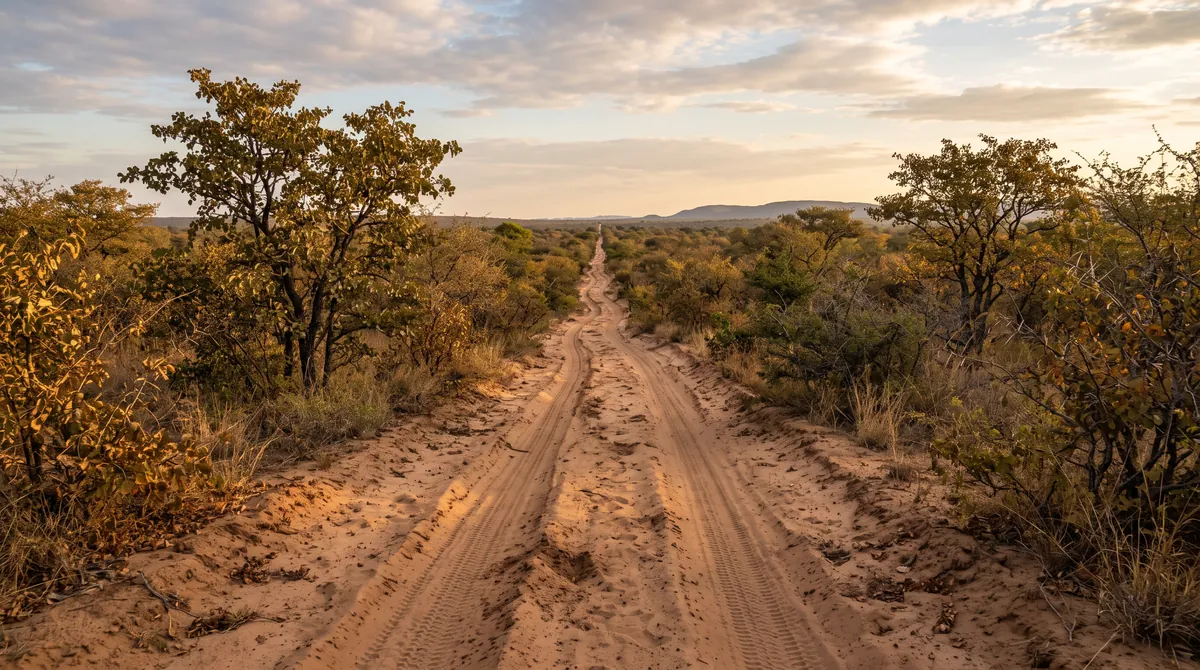
Deep sand. This is the defining surface of Moremi, Savuti, Khwai, and the Kalahari. Soft, dry sand swallows a two-wheel-drive vehicle within metres. You drive it by dropping tyre pressures, keeping momentum, and using low range. There is no shortcut and no way to fake it with the wrong vehicle.
Water crossings. Moremi and Khwai have channel crossings that range from ankle to bonnet deep depending on the flood. These need clearance, a snorkel, and the judgement to walk a crossing before driving it.
What happens if you take the wrong vehicle
Travellers who try Moremi or Savuti in an underpowered or two-wheel-drive vehicle usually get stuck in the first serious sand, often within the first hour. Getting unstuck in 35 degree heat, alone, with no signal, is exhausting and occasionally dangerous. Recovery call-outs in remote areas are expensive and slow, sometimes taking a full day to reach you. Worse, some rental agreements void your insurance if you take a two-wheel-drive vehicle into a 4x4-only area, leaving you liable for the full value of a bogged or damaged vehicle. The saving on a cheaper rental disappears the moment any of this happens.
How to rent the right vehicle
Rent from an operator that specialises in Botswana self-drive trips rather than a general city car-hire desk. Ask directly whether the vehicle has low range, a snorkel, two spare tyres, and recovery gear, and confirm that your intended parks are covered by the insurance. A reputable operator will also brief you on tyre pressures and basic sand technique at handover. If your route is tar and Chobe Riverfront only, say so and you may be offered a cheaper high-clearance SUV. If it includes any of the sand parks, do not let price tempt you into the wrong vehicle.
Automatic or manual for sand
Most safari 4x4s in Botswana are manual, and for deep sand a manual gives you the finest control: you choose the gear, feel the clutch bite, and keep momentum without the gearbox hunting. Automatics are available and perfectly capable in experienced hands, and they are easier for drivers not used to a clutch, but in soft sand you must drive them deliberately to stop them changing gear at the wrong moment. If you are comfortable with a manual, take it. If you are not, an automatic is better than fumbling a clutch you cannot operate smoothly, because smoothness matters more than the gearbox type.
Skills matter as much as the machine
The right vehicle is only half the equation. A properly equipped 4x4 driven badly still gets stuck, and a modest 4x4 driven well gets through surprisingly difficult sand. The core skills are simple to learn and worth practising: lowering tyre pressures to around 1.2 to 1.5 bar before soft sand, keeping a steady momentum instead of surging and braking, staying in the existing ruts, and reinflating on firm ground afterwards. A good operator briefs you on all of this at handover. Treat that briefing seriously, because technique is what keeps you moving.
A quick self-assessment by itinerary
Match the vehicle to where you actually plan to go. If your route is Chobe riverfront and tar roads only, a high-clearance SUV is enough. If it includes Khwai or the easier edges of Moremi, you need a proper 4x4 but the driving is moderate. If it includes Savuti, deep Moremi, or the Central Kalahari, you need a fully equipped 4x4 and genuine confidence in sand, or a supported self-drive with a guide vehicle alongside. Be honest about the hardest leg on your plan, because that leg sets your minimum vehicle, not the average.
Renting locally or bringing your own vehicle
Most international visitors rent in Maun or Kasane from a specialist who supplies the vehicle fully kitted for the bush, which is the simplest path and means local support if something goes wrong. Overlanders driving up from South Africa or Namibia in their own vehicle have the advantage of knowing their setup intimately, but they carry the burden of cross-border paperwork, their own recovery gear, and repairs far from home. For a first Botswana trip, renting locally from a reputable operator removes the most variables and is the recommendation.
Common myths about 4x4 in Botswana
A few myths cause real trouble. The first is that any all-wheel-drive crossover counts as a 4x4; it does not, because without low range it cannot crawl through sand. The second is that you can deflate a 2x4's tyres and get through; you cannot, because the clearance and gearing are simply not there. The third is that dry sand is easier than it looks; it is the opposite, because soft dry sand gives the least grip of any surface you will meet. And the fourth is that being careful substitutes for the right vehicle; in deep sand, hardware wins, and caution alone leaves you bogged.