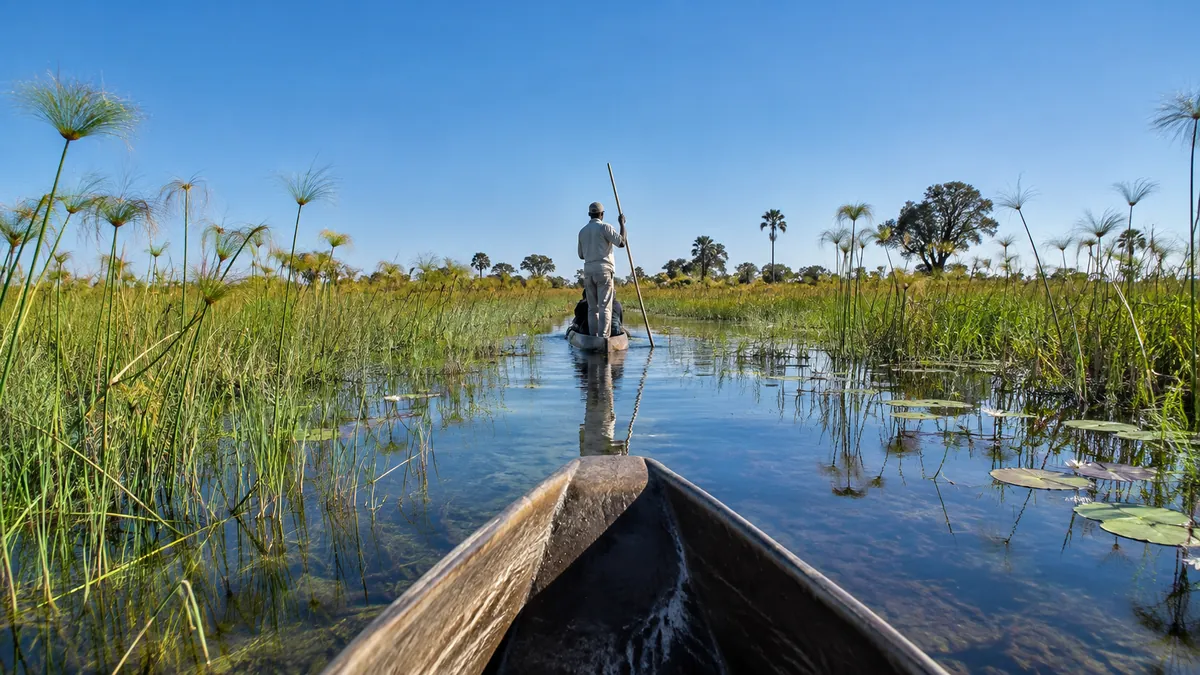
The Okavango Delta is a UNESCO World Heritage Site and one of the natural wonders of Africa. It is the world's largest inland delta, where the Okavango River from Angola's highlands fans out across the Kalahari sand to create a labyrinth of channels, lagoons, and islands covering up to 22,000 square kilometres during peak flood. For self-drivers, there is an important distinction to understand upfront: you cannot drive through the Okavango Delta itself. The Delta is water. The self-drive experience is Moremi Game Reserve (the accessible eastern edge of the Delta system) and the surrounding dry areas from which you can access the water by mokoro or boat. Understanding this geography changes how you plan. First-time visitors often arrive expecting to drive across the Delta to a lodge in the middle of the water. That is not how it works. The deep-water heart of the Delta is reached only by light aircraft or by boat from the fringing camps. Self-drivers work the edges, and the edges are extraordinary in their own right. The Khwai River, the Moremi floodplains, and the channels around Xakanaxa all put you beside the water without needing to be in it. Think of a Delta self-drive trip as three layers stacked together: the drive in through Maun, the game driving in Moremi and the community concessions, and one or two water activities (a mokoro morning, a motorboat afternoon) booked locally. Combining all three gives you the full range of what the region offers without the cost of a fly-in lodge.
What makes Okavango Delta special
The Delta's magic lies in the collision of water and desert. The Kalahari is one of the driest places in Southern Africa, yet the Delta floods every year, reaching peak levels in July and August, which is the middle of the dry season. This counter-intuitive timing creates a unique ecosystem where desert-adapted species and water-dependent species coexist.
The experience of gliding through the Delta by mokoro (traditional dugout canoe) is unlike anything else on the continent. The silence, the closeness to the water, the birdlife overhead, and the knowledge that hippos and crocodiles share the channels with you create an intensity that game drives cannot replicate.
The scale of the flood is difficult to grasp until you see it. The water that fills the Delta in July fell as rain in the Angolan highlands the previous summer, then travelled more than 1,000 kilometres down the Okavango River before spreading across the flat Kalahari sand. The delay means the Delta floods when Botswana itself is bone dry. This single fact explains why the region supports such dense wildlife in the middle of a desert.
The Delta is also a living system that shifts year to year. Channels that flowed last season silt up and close. New channels open where hippos have pushed through the papyrus. Islands grow and shrink. No two visits are identical, and local guides read these changes the way others read a map. That constant movement is part of why the Okavango feels alive in a way few other wilderness areas do.
Self-drive suitability
You cannot drive in the Delta proper. What you can do is drive to the edge of the Delta system through Moremi Game Reserve and then access the water from there. Moremi's campsite at Xakanaxa sits on a lagoon that connects to the wider Delta, and mokoro trips can be arranged.
Alternatively, day trips into the Delta are available from Maun. Several operators run mokoro excursions from the buffalo fence area south of Maun. These range from a half-day trip (3 to 4 hours, $50 to $80) to multi-day camping excursions in the Delta ($150 to $300 per day).
For the self-driver, the practical approach is to base yourself in Maun or at Moremi's Xakanaxa campsite and build one or two Delta water experiences into your itinerary.
The quality of a mokoro trip depends heavily on water levels and on your poler. During high water the mokoro glides for hours through open channels and lily-covered lagoons. During low water the same trip may involve the poler dragging the boat through shallow, muddy sections. Ask the operator directly about current water levels before you book, and set your expectations accordingly.
Motorboat trips are the faster alternative and cover far more ground. From Xakanaxa or from boat stations near Maun, a motorboat can reach deeper lagoons where hippo pods gather and where the larger fish eagles hunt. A boat trip and a mokoro trip complement each other: the boat for distance and big water, the mokoro for silence and intimacy. If your budget allows only one, choose the mokoro for the quintessential Delta feeling.
Best time to visit Okavango Delta
The Delta's annual flood cycle is the key to timing your visit. The floodwaters arrive from Angola between April and June and peak in July to August. This is the best time for mokoro trips: the channels are full, the wildlife concentrates on islands, and the water is at its most spectacular.
By October, the waters have receded significantly and many channels are too shallow for mokoro. The dry islands expand, and some of the magic is lost.
The green season (December to March) brings local rains. The landscape is lush and the birding is exceptional, but mokoro access is limited as the flood has not yet arrived.
There is a useful way to think about the mismatch between rain and flood. The local rains fall from December to March and green the land, but they do not fill the channels. The Angolan flood fills the channels from June to August, long after the rain has stopped. So the wettest-looking months on the ground are not the best months for water activities, and the driest-looking months deliver the fullest channels. Plan your water experiences around the flood, not the rain.
For photographers, the shoulder months of May and September are worth considering. In May the flood is rising and the crowds are thin. In September the water is dropping but wildlife concentrates heavily around the remaining channels, producing some of the most reliable game viewing of the year.
Vehicle requirements
Getting to Maun requires nothing more than a standard car (the roads are tarred). Getting to Moremi from Maun requires a 4x4 (deep sand tracks). If you are only doing a day mokoro trip from Maun, you do not need a 4x4 at all.
For the full Delta experience combining Moremi self-driving with mokoro excursions, the standard equipped 4x4 from a Maun operator is the right choice.
Wildlife highlights
The Delta's water-dependent species set it apart from the dry parks. Red lechwe antelope are everywhere, leaping through the shallows in herds of hundreds. Sitatunga (a shy, semi-aquatic antelope) hide in the papyrus beds and are virtually impossible to see anywhere else in Botswana.
The birdlife is the Delta's other great draw. Over 500 species have been recorded, including the African fish eagle (whose call is the soundtrack of the Delta), Pel's fishing owl, malachite kingfisher, and enormous flocks of open-billed storks.
Larger wildlife includes elephant herds crossing channels, hippo pods in deeper lagoons, and Nile crocodiles basking on banks. Leopards and wild dogs use the island edges.
The Delta is one of the last strongholds of the African wild dog, and the Moremi and Khwai areas hold some of the densest populations left on the continent. Packs range over enormous territories, so sightings are never guaranteed, but the floodplains around Khwai and the Xakanaxa area are as good a bet as anywhere in Africa. If you see a pack on a hunt, clear the narrow tracks and give them room; they move fast and cover ground in bursts.
From the water, the wildlife perspective changes completely. Elephants bathing at eye level, hippos surfacing a few metres from the mokoro, and crocodiles sliding off banks all feel far more immediate from a low boat than from a vehicle. Birders in particular find the water trips rewarding, with reed-dwelling species like the malachite kingfisher and the African jacana almost impossible to approach any other way.
Practical information
Maun is the base for all Delta activities. The town has supermarkets (Spar, Choppies), fuel stations, ATMs, vehicle repair shops, and a range of accommodation from backpacker lodges to hotels.
Mokoro day trips from Maun operate year-round but are best during high water (June to September). Book through the Okavango Kopano Mokoro Community Trust or any of the reputable operators in town.
If you are flying into the Delta for a lodge stay (not a self-drive activity, but worth knowing about), scenic flights from Maun range from $100 to $200 for a 45-minute flight and offer jaw-dropping aerial views of the Delta.
Maun rewards a methodical approach to supplies. Stock up fully before heading into Moremi or Khwai, because once you leave town there are no shops until you return. Buy fuel to the brim, draw cash (many community campsites and park fees are cash only), and confirm your campsite bookings in person if you can. The DWNP booking office and several reputable operators all have offices in town.
A sensible Delta itinerary gives Maun a full day at the start for provisioning and a half-day at the end for refuelling, laundry, and a proper meal before the long drive home. Rushing the Maun logistics is the most common way self-drivers run into trouble deeper in the system.
Getting there
Maun is the gateway town. It is accessible by tar road from Gaborone (approximately 1,000 km, 10 to 12 hours) or from Nata (approximately 300 km, 3 to 4 hours). Maun also has a domestic airport with daily flights from Johannesburg and Gaborone.
From Kasane, the drive to Maun via Nata is approximately 580 km on tar and takes about 7 to 8 hours.
The tar drive from Kasane to Maun is straightforward but long and can feel monotonous across the open flats near Nata. Break it with a stop at the Nata Bird Sanctuary on the edge of the Makgadikgadi system if the timing suits. Watch for livestock and the occasional elephant on the road, especially in the stretch between Pandamatenga and Nata, and avoid driving this route after dark when animals on the tar become a serious hazard.