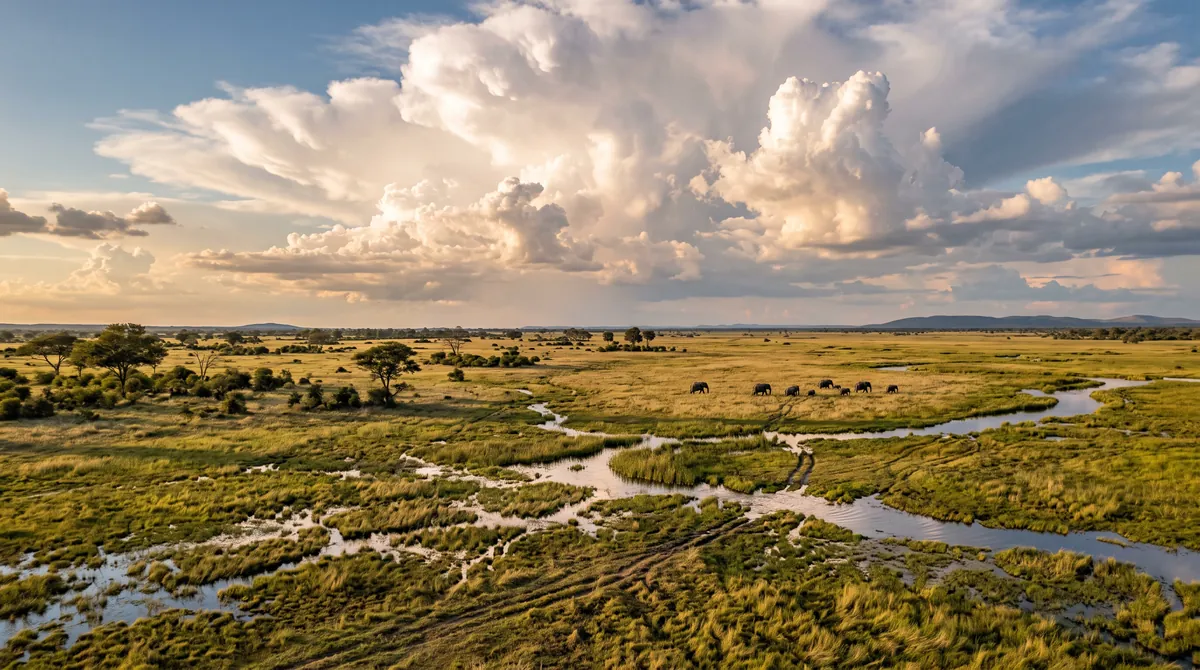
Savuti (also spelled Savute) is a section of Chobe National Park that feels like a completely separate wilderness. Centred around the enigmatic Savuti Channel and the wide Savuti Marsh, this area has a raw, remote character that sets it apart from the lush Chobe Riverfront to the north. The landscape is dry, open, and vast. Bull elephants roam in large herds. Lion prides here have been documented hunting elephants, which happens almost nowhere else in Africa. The name Savuti carries weight among safari travellers because so much of the wildlife documentary footage that defined African big-cat storytelling was filmed here. The open marsh, the long sightlines, and the sheer concentration of predators made it a natural stage for film crews. That reputation is deserved, but it comes with a caveat for self-drivers: reaching Savuti is genuinely hard, and the area rewards experience and preparation far more than it forgives mistakes. Savuti sits roughly midway between the Chobe Riverfront and Moremi, which makes it a logical pivot point on a northern circuit. Many self-drive itineraries run Kasane to Savuti to Moremi (or the reverse), using Savuti as the wild, remote middle act between two more accessible bookends. Understanding that position helps you plan fuel, water, and the number of nights you commit to the sand.
What makes Savuti special
Savuti's appeal is its wildness. The Savuti Channel has a mysterious history of flowing and drying up on cycles that scientists still do not fully understand. When the channel flows (which it has been doing intermittently since 2008), the marsh floods and attracts enormous concentrations of wildlife. When it is dry, the landscape is stark but the permanent waterholes become predator hotspots.
The bull elephant herds are Savuti's signature. These are not family herds led by a matriarch. They are groups of massive, old bulls, sometimes 30 or 40 together, moving slowly across the marsh. The lion prides in Savuti are large and bold, accustomed to taking on big prey. The Savuti lions have been filmed by National Geographic hunting young elephants at night.
The elephant-hunting behaviour is worth understanding because it is so unusual. During the harshest part of the dry season, when other prey has moved away from the drying marsh, a few Savuti prides learned to target young elephants at night, when the elephants cannot see well and the lions can coordinate in the dark. It is not a nightly event, and most visitors will not witness it, but it illustrates how the pressure of this environment pushes predators to extremes seen almost nowhere else.
Beyond the lions, Savuti holds one of the highest densities of spotted hyena in Botswana, and the interaction between the two species is constant. Clans of twenty or more hyenas will challenge a pride at a kill, and the resulting standoffs are among the most dramatic wildlife encounters in the country. Cheetah use the open marsh for daytime hunting, and the area is reliable for large raptors, including the martial eagle and the bateleur.
Self-drive suitability
Savuti is for experienced self-drivers only. The tracks are deep sand, especially the approach from Kasane, and the distances between any form of help are long. There is no fuel, no phone signal, and no assistance if you get stuck.
The drive from Kasane to Savuti (approximately 170 km) takes 5 to 7 hours on deep sand. The approach from Moremi via the Mababe Gate (approximately 80 km from Third Bridge) is shorter but equally challenging. In both cases, the reward is reaching one of Africa's most dramatic wildlife theatres.
The sand between Kasane and Savuti deserves respect. It is soft, deep, and relentless for long stretches, and it punishes drivers who have not lowered their tyre pressures or who try to power through on momentum alone. Drop your pressures to around 1.2 to 1.5 bar for the sand sections, keep a steady throttle, and avoid stopping in the softest patches where getting moving again is hardest. Travelling in convoy with at least one other vehicle is the single best safety measure for this route.
Timing your drive matters too. Start early so you reach camp with daylight to spare, because setting up in the dark in an area with this much predator activity is both difficult and unwise. Budget far more time than the distance suggests; 170 km of this sand can take longer than 400 km of tar, and a single recovery can cost an hour or more.
Best time to visit Savuti
July to October is the window. The dry conditions concentrate wildlife around the permanent waterholes, predator activity is at its peak, and the roads are at their most passable (which is still difficult by normal standards).
During the green season, the Savuti Marsh can flood partially, making some tracks impassable. The campsite stays open year-round, but reaching it becomes genuinely challenging from December to March.
There is a trade-off to weigh. The late dry season (September and October) delivers the most intense predator action as animals crowd the last water, but daytime temperatures can exceed 40 degrees Celsius and the landscape is dusty and stark. The early dry season (June and July) is cooler and more comfortable, with the marsh still holding some green, though wildlife is slightly less concentrated. For most self-drivers, July to September is the balance point between comfort, access, and game viewing.
Whatever month you choose, build in flexibility. A single heavy rain can turn sections of the approach track to Savuti into deep mud or standing water, and conditions change faster than any published road report can keep up with. Ask at the gate about current track conditions before committing to the drive.
Vehicle requirements
Fully equipped 4x4 with low range. This is one of the sandiest drives in Botswana. A long-range fuel tank or jerry cans are essential, as there is no fuel between Kasane and Savuti (170 km of sand driving uses significantly more fuel than tar).
Dual spare tyres, a high-lift jack, sand ladders, and a compressor are all strongly recommended. A satellite communicator is not optional here.
Most reputable Maun and Kasane rental operators equip their Savuti-grade vehicles with exactly this kit as standard, but do not assume it. Before you leave town, physically check that both spares hold air, that the jack and its base plate are present, that the compressor works off the vehicle socket, and that the recovery points on the chassis are solid. A puncture on the Savuti sand with a single flat spare and no compressor turns a minor delay into a serious situation.
Fuel calculation is the other non-negotiable. Deep sand roughly doubles fuel consumption compared with tar, so the 170 km from Kasane can burn the equivalent of 340 km of highway driving. Carry enough for the drive in, all game driving at Savuti, and the drive out, plus a reserve of at least 20 percent. Long-range tanks or two full jerry cans are the norm for this route.
Wildlife highlights
The Savuti campsite itself is one of the best wildlife viewing locations in Botswana. The waterhole in front of the camp draws elephants, lions, hyenas, and jackals throughout the day and night. Sitting at camp with a drink, watching a procession of wildlife at the waterhole, is the quintessential Savuti experience.
Look for the large bull elephant herds in the morning as they move across the marsh. Lion prides are most active at dawn and dusk. Spotted hyena dens are common in the Savuti area, and the hyenas are bold, often visiting camp at night.
The rocky outcrops south of the marsh (the Gubatsa Hills) are home to ancient San rock paintings and are worth a short hike if you have time.
Game driving at Savuti follows a simple rhythm. Mornings are for covering the marsh and the channel line while the predators are still active and the light is soft. The middle of the day is for retreating to camp and watching the waterhole, which does much of the work for you. Late afternoon drives pick up the cats again as the heat fades. Because the terrain is open, sightings here are often prolonged and uninterrupted, giving you time to watch behaviour unfold rather than snatching a glimpse through thick bush.
The marsh itself changes character dramatically depending on whether the Savuti Channel is flowing. In flow years, the grassland greens and waterbirds arrive in numbers. In dry years, the marsh is a pale sea of grass dotted with dead trees, drowned in an earlier flood cycle and left standing as stark silhouettes. Both states are photogenic, and both support the predators that make the area famous.
Practical information
Savuti Campsite is the only accommodation option in the area for self-drivers. It has recently been upgraded with new ablution blocks and improved sites. Book through the DWNP system well in advance for peak season.
There are approximately 15 sites, some with excellent views of the waterhole. Baboons and hyenas are persistent camp visitors; secure all food and never leave anything unattended.
Carry at least 40 litres of water per person and all food supplies. The nearest shops are in Kasane (5 to 7 hours of driving).
Getting there
From Kasane, follow the sand track south through Chobe National Park. The route is approximately 170 km and takes 5 to 7 hours. There is a gate at the start (near Kasane) and no further checkpoints until Savuti.
From Moremi, exit via the Mababe Gate and head north. The track to Savuti from Mababe is approximately 80 km.
From Maun, the most common route is through Moremi to Mababe Gate, then north to Savuti. Total distance is approximately 330 km, all on sand, and takes a full day.
Whichever direction you approach from, treat the drive as part of the adventure rather than a transfer to be rushed. There are no services, no fuel, and no reliable phone signal along any of these routes, so your vehicle and your preparation are all you have. Tell someone your route and expected arrival time, carry printed GPS coordinates as a backup to your device, and never attempt the final leg in failing light.