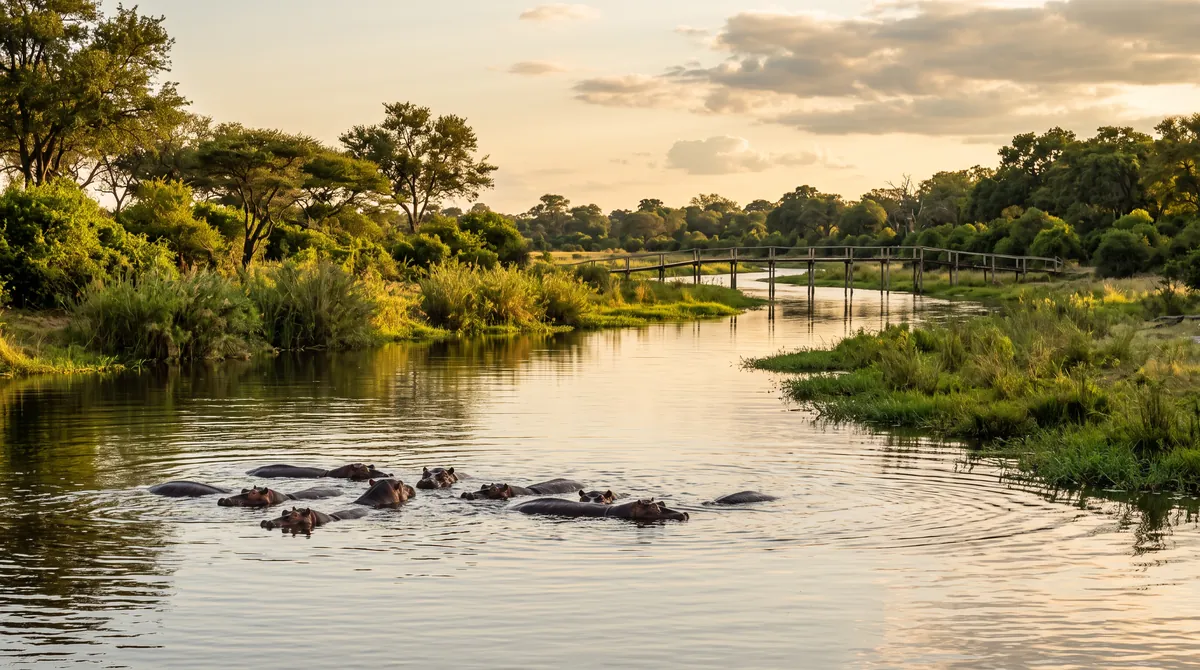
The Khwai Concession is a community-managed wildlife area on the northeastern boundary of Moremi Game Reserve. For self-drivers, Khwai offers something that national parks and game reserves in Botswana do not: flexibility. Because it is a community concession rather than a government-managed park, Khwai allows night drives, off-road driving, and walking. These freedoms make it one of the best-value self-drive destinations in Botswana. Khwai works best as a companion to Moremi rather than a standalone destination. Most self-drivers pair the two: a few nights inside Moremi for the classic reserve experience, then a move into Khwai for the night drives and off-road freedom that the reserve does not permit. Because the two areas share a boundary and the same wildlife, the transition feels seamless, and you get the best of both rule sets on a single trip. The community ownership model is worth understanding. Revenue from campsite fees and conservation levies flows back to the Khwai community, which has managed this land for generations. Choosing to camp here directly supports local livelihoods and gives the community a tangible stake in protecting the wildlife. For travellers who want their money to do more than buy a bed, Khwai is one of the clearest examples of conservation and community benefit working together in northern Botswana.
What makes Khwai special
Khwai's wildlife is essentially the same as Moremi's because there is no fence between them. Animals move freely between the reserve and the concession. The difference is in the rules.
In Moremi, you must stay on marked tracks, you cannot drive after dark, and walking is prohibited. In Khwai, you can follow a leopard off the main track, drive at night with a spotlight to find nocturnal species, and even do guided walks.
This makes Khwai the place for self-drivers who want to see species that are difficult to find during the day. Leopards are more commonly sighted on night drives. Honey badgers, porcupines, and genets come out after dark. The hyena dens are easier to observe.
The off-road freedom changes the quality of daytime sightings too. In a national park, a leopard that walks off the track is gone. In Khwai, a guide or an experienced self-driver can follow at a respectful distance and keep the animal in view, which transforms a fleeting glimpse into a proper observation. The same applies to wild dog packs, which rarely stay on the road when they are hunting. This flexibility is the single biggest reason experienced safari-goers rate Khwai so highly.
Walking is the other privilege Khwai offers. Guided bush walks, arranged through the community or a mobile operator, let you experience the ecosystem on foot: tracking, reading signs, and understanding the smaller details that are invisible from a vehicle. It is a different pace entirely, and for many visitors it becomes the highlight of the trip.
Self-drive suitability
Khwai is a good step up from Chobe for drivers building experience. The tracks are sandy but generally less challenging than Moremi's interior. The community campsites are well-established, and the Khwai village provides a point of contact if you need help.
The main risk is navigation. Unlike national parks with signposted junctions, Khwai's tracks can be confusing with multiple routes leading in different directions. A GPS with Tracks4Africa maps is essential.
The maze of tracks around Khwai is both a blessing and a trap. The multiple routes give you freedom to explore, but they also make it easy to lose your bearings, especially near the river where tracks split repeatedly to work around wet ground. Mark your campsite as a waypoint the moment you arrive, note the junction where you turned off the main road, and do not rely on being able to retrace your route by memory. Phone signal is patchy to non-existent, so an offline GPS or a dedicated navigation device is not a luxury here.
Water crossings are the other thing to watch. The Khwai River and its side channels have several crossing points, and their depth changes with the flood. Walk a crossing before driving it if you are unsure, check for a firm bottom, and never attempt one where you cannot see the exit. Hippos and crocodiles are present in the deeper pools, so keep crossings brisk and avoid lingering at the water edge on foot.
Best time to visit Khwai
May to October follows the same dry-season pattern as the rest of northern Botswana. Wildlife concentrates along the Khwai River, which forms the boundary between the concession and Moremi.
June to August is the sweet spot: flood waters from the Okavango system have reached the Khwai River, game is concentrated, and the dry conditions make the bush open for viewing.
Khwai is possible in the green season, but some tracks become waterlogged and the wildlife disperses.
The arrival of the Okavango flood in the Khwai River is a key piece of timing that many visitors overlook. The flood reaches this far corner of the system around June or July, filling the river and drawing game to the water. Before the flood arrives, the river can be low and the game more scattered. If riverfront wildlife is your priority, aim for the months after the flood has pushed through, which usually means July onward.
The green season still has its advocates. From December to March the bush is thick and green, migrant birds arrive, and the light after a storm is superb for photography. Predators are harder to find because prey disperses, but the newborn impala and other young animals bring their own drama as the cats target them. Just be prepared for waterlogged tracks and have the recovery gear and experience to deal with mud.
Vehicle requirements
A 4x4 is essential. The tracks are sandy throughout, with some sections requiring careful driving through deeper patches. A standard equipped vehicle from a Maun operator is sufficient. Low range will be needed in places.
If you plan night drives, ensure your vehicle has a good spotlight (most rental 4x4s include one) and that your battery is in good condition.
Wildlife highlights
The Khwai River frontage is prime predator territory. Leopards are regularly seen in the trees along the river, particularly in the early morning and late afternoon. Wild dog packs pass through frequently, and lion prides work the floodplains.
Night drives are Khwai's unique offering. Species you are unlikely to see during the day include African wild cat, large-spotted genet, honey badger, aardvark (rare but possible), and porcupine.
The birding along the Khwai River is excellent, with Pel's fishing owl a highly sought-after sighting in the tall trees along the water.
Elephants are a constant presence along the Khwai. Herds cross the river daily, and the old bulls often feed close to the campsites, so expect to share your space with them. They are generally relaxed, but give them room and never position your vehicle or your tent between an elephant and the water. The riverine woodland also holds good numbers of kudu, bushbuck, and the shy red lechwe on the floodplain edges.
For birders, Khwai is one of the richest stretches in northern Botswana. Beyond the famous Pel's fishing owl, the river supports saddle-billed storks, African skimmers on the sandbars, carmine bee-eaters in season, and a dawn chorus that makes the early starts worthwhile. Keep a bird list in the vehicle; it is easy to record fifty or more species in a single productive morning along the water.
Practical information
Khwai has several community-run campsites along the river. These are more rustic than DWNP campsites but offer beautiful settings with views over the floodplain. Some have basic ablution facilities, others are completely wild.
Campsite fees are payable at the Khwai Community Trust office in Khwai village. Rates are approximately P150 to P300 per person per night ($12 to $25). Community conservation fees are separate.
Khwai village has a small shop with basic supplies (bread, tinned goods, airtime) but no fuel. The nearest fuel is Maun, approximately 95 km south.
Because Khwai has no fuel and only the most basic supplies, treat Maun as your last proper resupply. Arrive with full tanks, enough food for your whole stay plus a day of contingency, and all the drinking water you will need, as the river water is not safe to drink untreated. Cash is essential for the community fees, which are not set up for card payments, so draw what you need in Maun before you leave.
Camp etiquette matters here more than in a formal park. Many Khwai sites are unfenced and share the landscape with elephants, hyenas, and the occasional lion passing through. Keep a clean camp, store food securely inside the vehicle at night, never leave anything scented in your tent, and keep a torch and your vehicle keys within reach after dark. Treated with common sense, the open camps are one of the most memorable parts of a Khwai stay.
Getting there
From Maun, head north towards Moremi's South Gate. Before the gate, take the signposted turn to Khwai. The drive is approximately 95 km on sand and takes about 3 hours.
From Moremi (Xakanaxa or Third Bridge), exit via the North Gate, which brings you directly to Khwai village. This is a natural progression for itineraries moving from Moremi into Khwai.
The short hop between Moremi North Gate and Khwai village is one of the most rewarding transfer drives in Botswana, running along the river with regular wildlife sightings. Treat it as a game drive in its own right rather than a transfer, allow a few hours, and you will often arrive at your Khwai campsite having already filled a memory card.