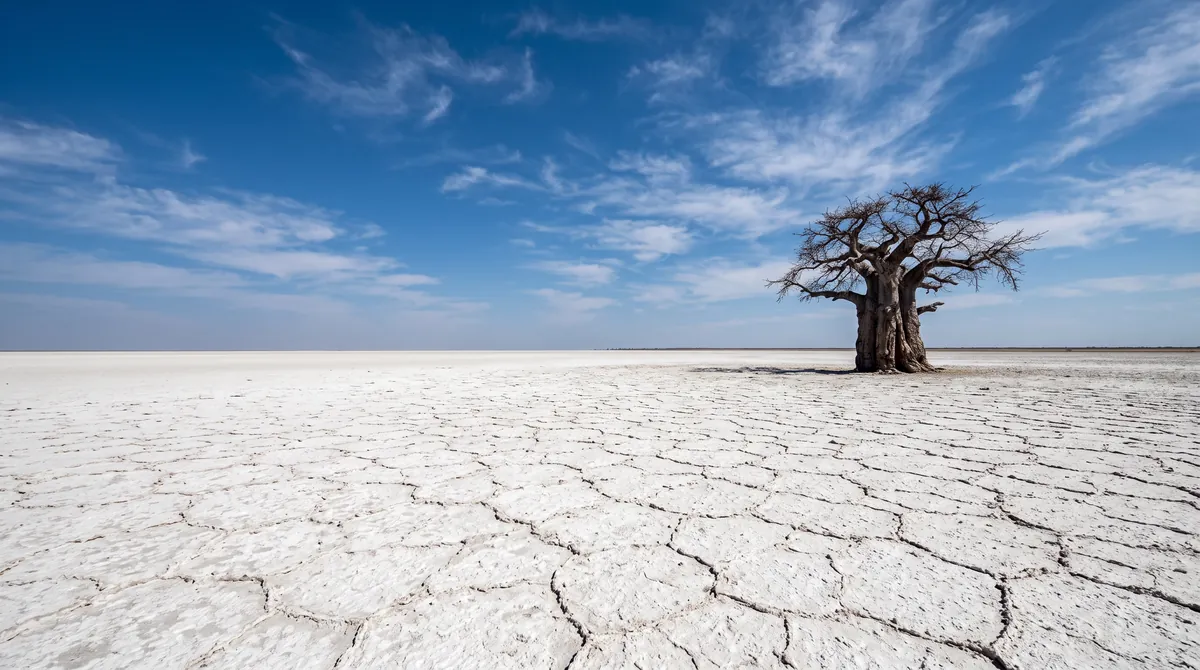
The Makgadikgadi Pans are the remnants of a vast ancient lake that once covered much of northern Botswana. Today, they form one of the largest salt flat systems in the world, covering over 12,000 square kilometres. The landscape is unlike anything else in Botswana: flat, white, and infinite. During the dry season, the pans are a cracked, empty expanse that stretches to the horizon in every direction. During the rains, they flood and attract one of Africa's last great zebra migrations. Geologically, the pans tell a story that spans hundreds of thousands of years. The ancient Lake Makgadikgadi once held more water than all of today's African lakes combined, fed by rivers that have since changed course or dried up. What remains is a pair of main pans, Sowa to the east and Ntwetwe to the west, separated by a strip of grassland and fringed by grass savanna where the game congregates. Scattered baobab trees, some over a thousand years old, mark the old shorelines and serve as navigation landmarks that early explorers and modern travellers alike have relied on. For self-drivers, the appeal is the sheer change of scale and mood from the rest of Botswana. After days spent in the dense mopane and riverine bush of the north, the open pans feel like another planet. There are no trees to block the view, no landmarks to anchor the eye, and on a still day the horizon dissolves into a shimmer of heat and salt. It is a place that rewards patience and a willingness to sit still rather than chase sightings.
What makes Makgadikgadi Pans special
Makgadikgadi is about extremes. The silence on a dry pan at midday is absolute. The night sky, with no light pollution for hundreds of kilometres, is among the best in the world for stargazing. And when the rains come, the transformation is dramatic: flamingos arrive in their tens of thousands, and the zebra migration brings over 25,000 animals through the area.
The meerkat colonies near the Makgadikgadi Pans are another highlight. Several habituated groups in the area allow close observation, and the meerkats will sometimes climb onto visitors for a better vantage point. This is one of the few places in Africa where you can have this experience.
The baobab clusters add another layer of interest. Kubu Island, a rocky outcrop on the edge of Sowa Pan covered in ancient baobabs, is one of the most atmospheric camping spots in Southern Africa. It sits in isolation on the white pan surface and carries real cultural significance for local communities, who regard it as a sacred site. Reaching it is an adventure in itself and best done with a guide who knows the current pan conditions.
Self-drive suitability
Makgadikgadi sits on a spectrum. The tar road from Nata to Maun passes the northern edge of the pans, and the town of Gweta is a comfortable base accessible in any vehicle. From there, day trips onto the pans require a 4x4.
Driving on the pans themselves is potentially dangerous. The surface can look solid but break through into mud underneath, especially during and after rains. Always use a guide for pan crossings, and never drive on the pans in wet conditions.
Makgadikgadi Pans National Park (the designated park area, separate from the wider pan system) has sandy tracks that require 4x4 but are less challenging than Moremi or Savuti.
Navigation is the real skill here rather than technical driving. On the open pans there are no tracks to follow, and a wrong turn can take you kilometres from where you intended. A GPS with waypoints is essential, and a paper map as backup is sensible. Mobile signal disappears quickly once you leave the tar, so tell someone your route and expected return time before you set off. The flat, featureless terrain that makes the pans so striking also makes them disorienting, and more than one traveller has spent an anxious hour trying to relocate a campsite after dark.
Best time to visit Makgadikgadi Pans
There are two distinct seasons, each with its own appeal.
Dry season (July to October): The pans are dry and crossable. Camping on the pan surface under the stars is one of Botswana's great experiences. Wildlife is sparse, but brown hyena sightings are more common in the drier months.
Wet season (November to April): The rains flood the pans, attracting the zebra migration (peaking around February to April) and flamingos. This is the more dramatic wildlife experience, but driving conditions are more difficult and some areas become inaccessible.
April to June is the transition period and often the best overall time: the migration is still present, the roads are drying out, and the crowds are minimal.
Stargazing deserves its own mention when planning timing. The new moon period in the dry season gives the darkest skies, and the Milky Way is so bright it casts a faint shadow. If astrophotography or simply lying out under the stars is part of why you are coming, check the lunar calendar and aim for the days around new moon. The combination of zero light pollution, dry air, and a flat horizon makes this one of the finest stargazing locations on the continent.
Vehicle requirements
Getting to Gweta or Nata requires only a standard vehicle (tar roads). From there, any exploration of the pans or the national park requires a 4x4.
For pan crossings, a guide with local knowledge is strongly recommended. The surface conditions change constantly, and getting stuck on a salt pan with no shade and temperatures above 40 degrees is a genuine emergency.
Wildlife highlights
The zebra migration (February to April) is Makgadikgadi's headline wildlife event. Over 25,000 zebra and associated wildebeest herds move through the grasslands south of the pans, following the rains and fresh grazing. The migration attracts predators, including lion and cheetah.
The habituated meerkat colonies near Gweta are a must-visit. The experience is intimate and charming, and the guides from the local camps are knowledgeable.
Birdlife peaks during the wet season. Greater and lesser flamingos gather in vast numbers on the flooded pans. Ostrich, secretary bird, and various raptors are common year-round.
Beyond the headline species, the grasslands south of the pans support healthy populations of springbok, red hartebeest, and gemsbok, all adapted to the dry conditions. Bat-eared foxes and black-backed jackals are frequently seen trotting across the open ground, and the fortunate few spot an aardvark or aardwolf in the early morning. During the wet season, the fresh grazing draws in the migratory herds and, with them, the predators that make the Makgadikgadi grasslands a genuine wildlife destination rather than just a scenic one.
Practical information
Gweta is the practical base for Makgadikgadi exploration. The town has basic supplies, fuel, and several accommodation options including Planet Baobab (a popular budget lodge and campsite) and Gweta Lodge.
Campsites within Makgadikgadi Pans National Park are booked through the DWNP system. The main campsites are at Khumaga and Njuca Hills.
Sleeping on the pan surface (outside the national park boundary) is an experience worth arranging through a local operator in Gweta. They provide a guide, navigate the pan crossing, and set up camp in the middle of the flat. The sunrise over the salt is unforgettable.
Supplies should be sorted in Maun or Nata before you arrive, as Gweta stocks only the basics. Fuel is available in Nata and Gweta, but carry enough to cover any pan excursions with a comfortable margin, since there is nowhere to refuel once you leave the tar. Water is the other essential: bring more than you think you need, as the dry heat is deceptive and dehydration creeps up fast on the open pans. A good rule is to plan for at least five litres per person per day in the hot months.
Getting there
From Maun, drive east on the A3 highway towards Nata. The turnoff to Gweta is approximately 200 km. From Nata, Gweta is approximately 100 km west on the same highway.
From Kasane, the route is via Nata (A33 south, then A3 west). Total distance to Gweta is approximately 500 km on tar.
The approach roads are tar and easy, which makes Makgadikgadi one of the more accessible stops to reach, but the character of the drive changes completely once you turn off towards the pans. Plan to arrive in Gweta or Nata with a full tank and your supplies sorted, because the moment you leave the highway you are committed to sand and self-navigation. If you are routing between the northern parks and the Central Kalahari, Makgadikgadi sits naturally in the middle and makes a logical two-night break to reset before the next leg. Time your arrival for the afternoon so you can set up and still catch the sunset over the salt, which is when the pans are at their most memorable.